Showing posts with label Boston. Show all posts

Thursday, October 6, 2011

What the Heck Are You Doing?

If you've been wondering what the hell I'm up to when I go weeks without making a blog post, you're not alone. My parents ask me similar questions all the time. Not because they're actually reading this blog. They're not. But, because they are very, very concerned about how I'm actually earning an income. Here's a sample phone conversation:

Dad: Well, hello...we haven't heard from you in a while. What have you been up to? Why hasn't there been a Melissa@Market piece on Zomppa recently?

Me: Now that the season is winding down, we are only running those a couple of times a month. But, I have a Food Fighters piece coming out every other week instead!

Dad: Hmm. Well, we're not really interested in those.

Me: oh.

Dad: What else have you been doing?

Me: Teaching classes, traveling, writing.

Dad: Do you get PAID for any of this stuff??

So, anyhow. I'm not sure if you've been wondering where I've been hiding because you're actually *interested* in what I'm learning and writing about or if you're just nosy as to how I survive on a day-to-day basis. My dad wants to makes sure I'm (a) alive and (b) supporting myself (legally). If those are your priorities also, then you can quit reading now. Here's a pretty picture for you to leave on:

Gorgeous mural from my last Philly trip

Actually curious on how I've filled the last 2 1/2 weeks? Here's a brief recap that I'll hit more in depth soon. (I know, I know...I say that a lot. Just trust I have good notes and an *excellent* memory.)


  • Attended the Philabundance Hunger Symposium.  We all already know I've got it bad for Philabundance, but the conference was seriously one of the best 1/2 day events I've ever attended. It was jam-packed with energy, innovation and knowledge. Mari Gallagher spoke about her research on food deserts and Joel Berg gave a rousing anti-hunger speech. And that was just the last 1 1/2 hours. Must find a way to condense soon.
  • Spent a lovely evening at Talula's Garden. The company was unbeatable even if the food was a bit uneven.


  •  Traveled to Chicago. But only after being held hostage in the Philly airport by United Airlines for almost 9 hours. Managed to run into both Joe Theissman and Michael Jordan though, so things were not all bad.

This view from my Chicago hotel room did not suck
  • Visited with the kind and generous Kevin Pierce of The Resource Center. The Resource Center in Chicago runs a variety of projects aimed at connecting individuals and businesses, creating equality and evening the food supply. 


  • Spent an evening with a dear friend eating at the sleek pub The Gage on Michigan Ave. 

  • An early start to check out a couple of local farmer's market including the large Green City Market at Lincoln Park. 
  • A morning tour of one of Growing Power's farms in inner city Chicago where I learned about their upcoming hydroponic project and saw their compost worms in action.


  • Brunch at Rick Bayless's Frontera Grill where I scarfed down this wonderfulness.


  • Attended City Farm's (a division of The Resource Center) Urban Harvest Festival where I saw some of the most gorgeous produce I've ever seen in an urban farm. 

  • Back in DC, tried out a new class with Academy of Hope that I call "One Method, Many Meals". Basically, it involves sauteing protein and veggies and combining them with various Latin, Asian, Italian flavors plus how to turn this knife and fork dish into a soup or frittata. All meals are under $5/serving and feature readily available ingredients. More on that later.


  • Attended the National Food Policy Conference at the Capital Hilton and enjoyed hearing panels on everything from global hunger to nutrition education to the Philadelphia healthy foods initiative. A really solid day of information.  
And that's why my brain is about to explode. Stay tuned.

Thursday, September 15, 2011

Where I've Been and Where I'm Going

A sale chart from the entrepreneurial kids at City Blossoms in WDC
Three months ago, I started this project officially. Time has flown by so quickly, I still feel I haven't adequately addressed half the things I've learned. I'm optimistic though that in the end it will accrue to create one (sort-of?) seamless flow that might be useful not just to myself, but others. One thing is for certain, and that is the fact that all the organizations I've visited so far have been amazing in their own right. I've visited places in Boston, Philadelphia and my hometown of Washington, DC so far, and next week, I'm off to Chicago.

A downtown Philly pop-up garden designed to utilize temporarily empty space.
My visits have been centered around observing three main areas of food equity: production of food, distribution of food and education about food. I've also tried to incorporate any businesses that might be involved in creating a larger network of local, sustainable food for a city. Of course, many places overlap in their focus. Here, I group them loosely based on the central premise of their organization.

I welcome suggestions for more visits and stops! Please use this blog, the email, Twitter or Facebook to send them my way!

Visitors tour Common Good City Farm in WDC
Production
Common Good City Farm, LeDroit Park, Washington, DC: Read more about this 1/2 acre urban farm in my Zomppa post or in this blog post. Best take away: The abundant amount of plant life that can grow in a small space on a former elementary school baseball field. Peach trees! Peach trees!
City Blossoms, Shaw Neighborhood, Washington, DC: I just visited with City Blossoms at their Marion Street location this past week and doggone if I didn't leave with the biggest case of the warm and fuzzies. This spot really puts the "community" in community garden. As with Common Good, education about gardening and fresh food is part of the package. The emphasis here is on kids, but all sorts of community members and volunteers participate.

The Food Project, multiple locations, Boston, MA and surrounding areas: Although the Food Project operates several farms in the greater Boston area, their focus is equally split on growing food and growing community. Teaching youth leadership skills is a majority part of this 20-year old organization's goals. They also work to distribute the food they grow to areas of the community in need, often partnering with health organizations, schools, and youth groups to promote healthy eating. You can read a little more about what I've written about them here.
Walnut Hill Community Farm and Philly Rooted, West Philadelphia, PA: There's a lot more to what Nic Esposito has going on then just this farm outside of a Septa station on Market Street. He's also a big proponent of local entrepreneurship and community mobilization. This farm is ingenious not just for its use of space, but for its design, such as a drainage cistern and pipe that slopes down the public transit system's roof. (Yep, they managed to get through all the government red tape for permission to do it!)
Pennsylvania Horticultural Society: Ok, so they're clearly involved in gardens. But, did you know this organization (originally founded in 1827) also runs a prison greenhouse program and a work release "Roots to Re-entry" program? Their training classes to help organizers start community gardens is innovative in that they focus only 1/3 on actual gardening and 2/3 on community mobilization (often the most difficult component of starting a neighborhood garden). The City Harvest program connects gardeners who can grow surplus with food security organizations that might use it.
Greensgrow, Philadelphia, PA: One of the original urban "gardens" in Philadelphia. Also runs a farmer's market, CSA, and nutritional cooking classes. 


The greenhouse at Greensgrow in Philly, PA
I'll be adding to this list in Chicago where I'm scheduled to stop at:
City Farm, Chicago, IL: Not only will I be touring this farm and speaking with a director at the organization (The Resource Center) that runs it, but I'll also be attending their fall Urban Harvest event.
Growing Home, Chicago, IL: Both exploring this farm and speaking with someone to learn more about their programs.
Gary Corner Youth Center Gardens, Chicago, IL: Another scheduled garden stop!


Distribution
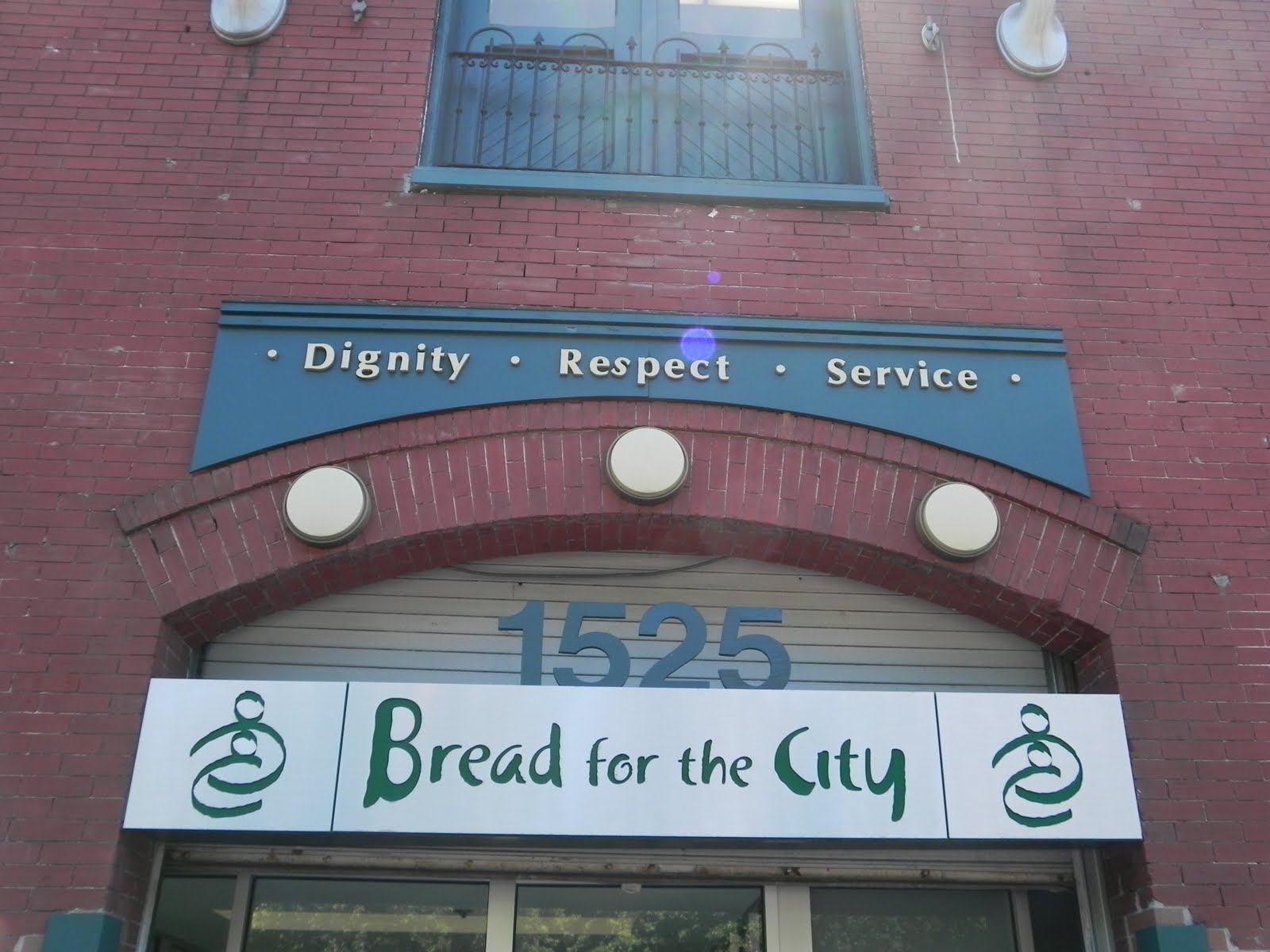
Bread for the City, Shaw and Anacostia neighborhoods, Washington, DC: I've worked with BFC for several of their farmer's markets. They are an immense organization of wrap-around services that do much more than hand-out food. Education is also a big priority here to ensure their clients become self-sufficient and independent as the ultimate goal. You can read some more about them here and here.
Community Servings, Boston, MA: Originally founded as a healthy food delivery service for those suffering from acute illnesses, Community Servings has expanded its offerings to include nutritional cooking classes that utilize fresh produce and farmer's markets whose proceeds help support the non-profit. Both offer provisions that make them accessible to a wide range of incomes.
SHARE, distribution from West Philadelphia to areas of PA, DE, NJ shore, MD shore and metro NY: SHARE acquires food from the USDA's commodity program and supplements it with local farm goods to create weekly "boxes" of groceries that are then sold for a fraction of the retail cost. Federal and state assistance monies as well as cash can be used to purchase a box which is picked up at a local distribution site.
Philabundance, greater Philadelphia, PA: Philabundance grew out of a food bank system, but does much more beyond mere distribution. If you want to hear me turn all gooey and wax philosophic about them, check out this post.  They have a lot going on! And it's all fabulous!

I'll be adding to this list in Chicago where I'm scheduled to take a peek at the:
Fresh Moves Bus, various locations, Chicago, IL: This produce stand on wheels takes reduced price produce into underserved areas of Chicago.


Working in the City Blossoms Marion Street Garden
Education
Haley House, South End, Boston, MA: Haley House has a wide variety of wrap-around services, but several of their growing projects involve food education and training. I recently wrote about them here on the blog. 
Cambridge Community Kitchen, Cambridge, MA: A fledgling business hoping to host both local, nutritional cooking classes for a variety of populations as well as provide a separate kitchen to serve as an incubator for start-up food businesses.
Chefs Move To Schools, nationwide: A component of Michelle Obama's "Let's Move" initiative, this program helps to pair those trained in culinary arts with a local school. Resources and ideas are provided online to help chefs and schools incorporate food education. I was recently paired with Takoma Park Educational Center and am looking forward to starting a food exploration unit there. 

This does not even cover the other local DC organizations I partner with who are interested in nutritional cooking education for their clients.  These places include Even Start, Academy of Hope, Unity Healthcare, and the Latin American Youth Center among other non-for-profits.


Shoppers choose from the fresh produce at FreshFarm Market in WDC

Local Sustainable Food Systems
Crop Circle Kitchen, Jamaica Plains, Boston, MA: A food business incubator that carefully and selectively screens potential businesses to maximize efficiency. In addition, CCK provides detailed guidance on running and growing a business. The founder also runs a distribution hub called OrFoodEx that allows small producers and buyers to link up in a way that minimizes costs.
Boston Local Foods, Boston, MA: A linking organization for local businesses and producers designed to emphasize location, fairness and sustainability in the food system. I'll be attending their Boston Local Foods Festival on Saturday, Oct. 1. 
FreshFarm Markets, Washington, DC area: A non-profit that organizes 11 markets in DC, VA and MD filled with farmers from within a 200-mile radius. Several of their markets accept SNAP and WIC and utilize a program called "Double Dollars" that matches federal funds up to a specified amount. And, of course, there's the awesome FoodPrints kitchen , curriculum and garden at Watkins ES.  I frequently work at their markets doing simple cooking demonstrations with the produce and am looking forward to participating in the Watkins program soon! 
Fair Food Philly, Philadelphia, PA: Fair Food Philly began as a way to connect restaurants with local farms and has grown to include schools, institutions and the public at large. A leader in linking food networks in the city. 


Fair Food Philly's Farmstand at Reading Terminal carefully describes where the food originates and how it is produced

Saturday, September 10, 2011

A Helping Hand at Haley House

September is Hunger Action Month. Each week, Food Fighters will be posting features on some of the amazing organizations around the country fighting to make sure all Americans have access to fresh, healthy food. To learn more about, Hunger Action Month or how you can volunteer in your neighborhood, visit the Feeding America website or follow them on Twitter @FeedingAmerica or #HungerActionMonth.


Scattered across a neighborhood in the South End of Boston are a network of facilities under the name of Haley House.  Since 1966, this institution has been a house of hospitality for those transitioning out of homelessness, and, later, anyone faced with disenfranchisement. From housing to jobs to healthy meal preparation to revitalizing abandoned urban areas, Haley House has evolved with the community in which it exists. It is an excellent example of an organization that began by responding to an perceived need and adapted to new inequities as they became apparent.


Haley House organizes a variety of projects aimed at giving individuals who are struggling not a hand-out, but a hand up. Creating community is of the utmost importance in all Haley House does as is a marked desire in seeing people become self-sufficient.  Some of their outreach work includes:

  • Haley House Transitional Employment Program: A work experience program for those recently released from incarceration that focuses not just on training in the kitchen, bakery and catering enterprises, but predominately on life skills. The program teaches participants how to be successful in maintaining a job, home and finances and also in managing interpersonal relationships on a variety of levels.
  • Take Back the Kitchen: Works with urban students and some adults to learn basic healthy kitchen and nutritional skills. Participants have included charter schools, gang-resistance programs, anti-obesity clinics and college students among others.
  • Haley House Bakery&Cafe: A community cafe that helps to financially support Haley House's other missions.  The Cafe serves made-from-scratch food and fair trade products from a variety of ethnicities and often employs graduates of other Haley House programs. It is also a common spot for community gatherings and forums.
  • Food Program (Soup Kitchen and Pantry): Feeds the elderly, families and homeless who are in need.  The Soup Kitchen meals provide an intimate environment to eat in a community atmosphere. Meals are made with fresh produce from Noonday farm and place an emphasis on healthy, nourishing food.
  • Noonday Farm: A biodynamic farm that provides over 6,000 pounds of food per year to food banks and the Haley House kitchens.

To learn more about Haley House or how to contribute, visit here.

Wednesday, August 10, 2011

Hope Beyond Yourself

Dogs know August

August is a rough month.  The weather is scorching, summer's freedom is ending, and it seems like the world is sucked into its humidity drenched stupor.  It's easy to get lost in the bad news, or dwell on your own shortcomings, rather than think of the promise of tomorrows to come.

Just in time, the Washington Post placed this article on the front page of today's paper.  It's all about how, in the midst of the looming debt crises, rioting in London and seemingly endless streams of bad news, we can still find the simple joys in life.  A dog rolling in the grass, the last serving of a food truck speciality, lunch with your beloved in the middle of the day.  More importantly though, it illustrates how if we frame the world in the light of good, we can have the will to conquer the bad.  Hope in mere possibility is half the battle.  Maybe more.

Light, meet End of Tunnel

This past weekend, a video with Matt Damon fuming at why most teachers do what they do (their love of the job and belief in its importance *not* job security) went viral.  Having been a teacher, and being friends with so many teachers, I, of course, agree.  The world is filled (maybe not quite as filled as it should be, but examples abound none-the-less) with people who do what they do because they believe in it.  Not to become famous, not to become rich, not to have power, not even to make their lives "comfortable", but because they passionately and whole-heartedly believe that what they are doing can change someone else's life.

This is why I have such trouble posting in a timely manner about the "Food Fighters" I visit.  How can I adequately represent these individuals who are usually doing the work of 2-3 people, fighting a battle they'll likely never see the results of in their own lifetime, sacrificing vacation time/family time/personal time, and a decent salary, all without even considering these things an actual sacrifice compared to the people they aim to reach?  I am humbled on a daily basis by the commitment of the people I meet.  But mostly, I am inspired by their hope.  They truly believe that the world not only should change, but can change.


Two weeks ago, I participated in another Bread for the City farmer's market.  This time, it was at their location in Anacostia- a historically, low-income, crime-plagued area of the city.  The day was sweltering.  I must have had a 100 excuses roll through my head about not showing up to do my cooking demo.  Still, I arrived to find tents set-up, produce out and a full arsenal of employees and volunteers already soaked with sweat at 9:30am.  The line of people waiting for opening time took up a whole city block.  When the market started, BFC gave away 3600 pounds of produce in under an hour causing a near riot.  They broke up a fight, managed huge crowds disappointed at how fast the produce went, talked to clients about future needs, and then, immediately starting planning their next event (5000 lbs is the new goal).  While I went home to peel out of my drenched clothing and shower, they went back to work at their offices for another 5 or 6 hours.  That can't be blamed on mere dedication.  I think what you're seeing is hope.

People involved in food justice lift my spirit.  I mean, what other field would you find people who say things like, "Oh man, I wish I could join you on the tour of Detroit!"  Or, "If I had time for vacation, I would totally join you in the SouthEast."  While most people dream of beaches and mountains and someone delivering drinks for a summer retreat, I find people considering a tour of inner-city Chicago.  The desire to find out more, do more, learn more about how to conquer food injustices is overwhelming.

Then, there's the willingness to share.  Everyone says yes. I sit in front of my inbox every day in awe of the response to this project.  Strangers (Fan Watkinson, Megan Bucknum, I'm talking to you) have volunteered to give up whole days arranging schedules for me in different cities.  (Megan: "I have Friday afternoons off.  So, why don't we meet at my office and then, I can take you to places X, Y, and Z."  On her DAY OFF, people.  For me, a stranger.  Remarkable).  People who already work over 12 hour days have taken hours to discuss what they do and what I do, share ideas and bought me lunch to boot!  (Thank you, JD Kemp and Darnell Adams of Crop Circle Kitchen.)  I've been invited into people's homes and given garlic straight out of their garden's (JJ Gonson of Cambridge Community Kitchen).  Organizations have welcomed me in the midst of their busiest season and invited me to attend some of their marquee events (See: The Food Project.)


And the only reason I can think of (since less than 1% of America has heard of the magazine I write for) is their passion and hope.  "Yes!  Let's talk about it!" they respond.  "We'd love to share what we're doing."  It's the "let's take this to something beyond ourselves" motivation.  Where do I find the words for this type of humbling generosity of spirit?

I think the only way I can do this is by hoping, too.  Not hoping that my own life will improve (although, I think it's fine to hope that, too), but by believing that together we can and will bring change in food insecurity, the environment and nutritional, affordable food.  I'm questioning, observing, reporting, because I believe in hope beyond my own life.  Like the outstanding individuals I visit, I believe in the possibilities of the future.


Take that, August.


Tuesday, August 9, 2011

What Went Down in Beantown (Professionally)

Boston Gardens
Boston.  It was incredible.  Loved the city.  Loved the people I met with. Loved the architecture. Loved the restaurants.  Loved the local food scene.  Loved the people.  And the boys were *real* cute.  (What?!  Like I've said, focused...not dead.)

State House
I've described driving out to the Food Project's farm in Beverly, and the lovely afternoon I had on the grounds.  After the sweaty ride back to the city (seriously stinky and filthy but much more direct), I made the decision to check into the hotel, take a quick shower, ditch the rental and be a few minutes late for my second meeting.  (Trust me, it was for the best or our meeting would have been a *lot* shorter.)  I stayed at the Ames Hotel in the financial district of Boston.  The location isn't perfect, but the hotel pretty much is - more on that later. Then, it was off to Haley House for the first of two meetings there.

Gorgeous Lobby at the Ames
Saturday was filled with two more meetings.  (Little bit of a late start on Saturday...we can cover that in the post of what I did for "fun" in Boston.)  The first meeting was back at Haley House.  Afterwards, I took a crash course in the Boston bus system where I was graced with the kindness of a local floral shop owner.  When I ducked into her shop to ask a question about the bus stop (yes, so very tourist of me, but getting on the wrong bus was not an option), she insisted upon waiting for the bus with me and then swiping her bus pass for my ride.  Would not accept money.  This is what I meant when I say I loved the people in Boston.  I consistently met people not only helpful, but friendly and genuine.  (When you  spend most of your time in the Nation's capital, trust me, genuine holds a lot of sway.)  Safely on the bus, I took a short 20 minute ride across the Charles River, through the campus of MIT and into Cambridge.  In a small coffee shop, I met with JJ Gonson the owner and board member of several local food businesses.

Downtown Boston- I mean the architecture is unreal!
Saturday night and Sunday were basically free (in theory, free for writing...yah, well, we see how that worked out).  I checked out the SoWa farmer's market for M@M and otherwise explored the city and its food.  (Described in upcoming post).  Monday began with an early phone interview with a nutritionist from Community Servings and then a drive (much more successful this time...no tunnels) to Jamaica Plains for a visit to Crop Circle Kitchen.  Then, a sad drive back to the airport (so easy that I'm not sure how the debacle on Friday ever happened) where I was trapped by bad weather for six hours (and could have been writing pieces like this).

Here's a little bit more about the fantastic organizations I spoke with and toured on my trip:

The Food Project: Operating since 1991, the Food Project has evolved into an organization with ties criss-crossing the Greater Boston area. Their mission is three-fold and advertised on the T-shirts youth participants wear: Youth Food Community.  Besides increasing food access and teaching teenagers about leadership, responsibility and job skills, the organization builds community by creating groups of youth to "work" each farm (they have 6) that draw from a variety of different demographics.  Participants apply to be a part of the program beginning with a summer program.  Here the goal is to build awareness about fresh, healthy food and highlight leadership skills.  From there, students can apply for an academic year position where they will work on the farm after school, guide weekend volunteers and practice public speaking skills. Finally, youth can progress to the deepest level of participation at the internship position where they lead classes for their peers in the community on cooking and nutrition.  Besides conducting these community classes on food and nutrition, the Food Project also uses the produce they grow on their farms for CSAs, Farmer's Markets and hunger relief organizations.


Haley House and Cafe: Haley House has existed since 1966 as a transitionary location for those without housing or jobs.  The program has grown from housing and a soup kitchen as needs have arisen.  The Cafe, open since 2005, operates two programs.  "Take Back the Kitchen" is a program that works with at-risk youth as well as urban college students and some young adults to train them in job skills and nutritional cooking. The"Transitional Employment Program" works with formerly incarcerated individuals to give them real-life employment experience in the Cafe.  These individuals also receive tutoring and transitional support to ensure their success.  The Cafe is a fully functional dining establishment that also serves as a gathering spot for community residents to partake in nutritious, freshly prepared food.  Game, movie and reading nights are held often.  Proceeds from the cafe help fund other Haley House programs.


CuisineEnLocale/Cambridge Community Kitchen: Both of these businesses focus on utilizing fresh, local foods.  Cuisine En Locale is a catering and food delivery service that uses only locavore ingredients.  Cambridge Community Kitchen is in development but hopes to serve in two capacities.  One kitchen will provide an incubator for small food businesses to grow and receive advice and training in addition to providing commercially licensed space.  The other kitchen will be zoned for education-based services and classes in the use of nutritious, fresh produce for meals aimed at a variety of demographics.  JJ Gonson, head of both enterprises, is a dynamo when it comes to local food, sourcing 80-90% of her ingredients locally.  So impressive!


Community Servings:  Community Servings' main mission is to deliver meals to individuals who are suffering from life-threathening illnesses.  The nutritionist on staff I spoke with described some of the additional nutritional services the organization provides.  Community Servings recently began operating a Farmer's Market that includes a cooking class on how to utilize in-season produce (similar to what I do).  The Market accepts SNAP and all are welcome; able-bodied clients of CS are particularly encouraged to attend.  In addition, Community Servings' nutritionist teaches weekly produce-driven cooking classes that promote low-cost recipes and include a grant that allows participants to take home a Farmer's Market coupon/voucher that enables them to purchase many of the ingredients used in class.


CropCircleKitchen and OrFoodEx: Crop Circle Kitchen is a very successful business incubator kitchen. Its main purpose is not just to provide commercially licensed kitchen space for burgeoning food businesses, but also provide in-depth counseling in business planning and potential growth.  Companies are carefully selected based on their desire to succeed and their thoughtfulness in endeavor. OrFoodEx (short for Organic Renaissance Food Exchange) is a developing enterprise aimed at connecting local purveyors to local businesses in an affordable and accessible way by making use of group storage facilities and materials for transport and avoiding obstacles of scale, cost, geography and distribution.  It's basically an online forum for buyers/sellers to connect without paying a middle man while also providing warehouse and logistical support.  JD Kemp runs both companies and, really, I think he's brilliant.


Look for more of what makes these organizations unique in an upcoming post!


Finally, in case you missed it, the feature piece on Common Good City Farm is up on Zomppa.  Click here to check it out!

This week's M@M is also up.  Treat yourself to some of these zingy lemon/lime/basil cookies!


Thursday, August 4, 2011

Blogged Down

Boston Public Gardens.  No, I did not ride in the swan boat.
I'm behind in my blog posts, and that's predominantly because I keep thinking I'll have time to sit down and really dig into these organizations to give them what I feel they're due.  In Boston, I took in so much information in such a short period of time, I feel lucky part of my brain didn't ooze out my ear. Unfortunately, what this has resulted in is no activity on the blog, period.  That's not so good.  This was my first out-of-town trip, so it's all trial by fire as to what will work.

Boston Skyline from Washington St overpass.  I could have spent days just wandering and looking at the architecture in Boston.
(Here's what might not work: Trying to cram in as much play as business.  The reason I wasn't blogging last week when I returned from Beantown was because I was sleeping.  As in, 13 hours a day.  Hi Flame! Meet candle at both ends!)
This is a guinea hen I met while visiting The Food Project's farm.  Did you know what a guinea hen looked like?  Me, either.  
For now, let's just catch up over the next week with four posts.
Post One: The food organizations I visited in Boston and quick synopses (hey, that's a real word! I wasn't spell-checked!) of each.
Post Two: The fun stuff I saw, ate and visited in Boston.  (Um, maybe I had a little *too* much fun in Boston.)
Post Three: Boston's local food scene as a whole and what I'd still like to see/learn about in the future.
Post Four: What I learned to take forward into Philly!  (Rapidly approaching on August 25.) and beyond.

On my Sunday off, when I should have been, um...WRITING, I wandered the city instead, taking pictures like this one in the Back Bay.
Hopefully, Post One will be up by the end of the day.  Until then, amuse yourself with my latest posts over at Zomppa.  Last week's Melissa@Market on the SoWa Boston Farmer's Market and this week's featuring my dog's latest shenanigans while I was out of town.

Here's a hint as to what Lola was up to while I was in Boston.  I now have one of these on my refrigerator.

Thursday, July 28, 2011

Bountiful Boston: Stop One


I’ve got to say Boston didn’t start out on the finest foot.  Thursday night before leaving I dropped my phone again, this time rendering the SIM card useless approximately 5 minutes after the Apple store had closed for the night.  I spent a long two hours worrying if I could pull off 4 appointments on a Friday without a phone. 
It turned out that the phone function was to become utterly secondary to GPS.  Luckily, I didn’t have to worry about either as my brilliant friends M&G managed to take humpty apart and put him back together again before I left town.  With a full signal, I headed out on my Friday flight ready to face the day. (Oh, silly...of course, it wasn't a full signal on the plane! I was in 'airplane" mode, naturally.) An added perk was my upgraded seat thanks to S (who I already adore, but now adore even more), especially since the flight was full of screaming children and uptight business men.  I had plenty of my own space to work on the plane which actually inspired me to DO work. (Usually I am overcome by magazines or sleeping on plane rides.)

The farm and lands The Food Project shares with the Trustees of Reservations

Things went slightly downhill when I picked up the rental car to head out to Beverly, MA, on the North Shore, for lunch with the Food Project.  Along with the 100+ degree temperatures, the Boston highway system overwhelmed me before I was even off airport property.  Trapped in tunnels with no apparent exit, my GPS didn't appear to be of much use.  Every few seconds, it would tell me "Turn left on Mass Ave." or "Turn right on Commonwealth."...in a funny, but not funny ha-ha, way the GPS was apparently guiding me via the streets *above* me, not the subterranean hell in which I was trapped.  In short, let's just say I saw a LOT of Boston and its suburbs before I finally got pointed towards Beverly.   


But, arrive, I did, and The Food Project was incredible.  As I told their outreach director, I'm really not sure if seeing them as one of my first visits will help set a standard of comparison (i.e., aim for *this*) or completely dishearten me that no one can reach this same level.  Of course, they are celebrating 20 years of running the program, so I guess that can't hurt your awesomeness factor.


The view from the Trustees of Reservations' Children's Garden down to the Food Project's Farm and Tents
  
I arrived at the Long Hill farm (just one of the Food Project's several farms around the Boston area) around 11AM and followed the explicitly helpful directions from their website to park in the correct location.  As I walked towards a cluster of females wearing "Food Project" t-shirts, I knew my contact was not there (he's a male...that was a good giveaway).  The girls, however, were very helpful- making phone calls to ascertain who I was, talking to me about the grounds, showing me in to the farmhouse to meet another Food Project staff member.  It was only after they adeptly managed a stranger in their midst that I found out these girls were actually the kids who work in the Food Project's summer program.  Yep, they were teenagers.  That was my first indication that the Food Project is doing some serious leadership and character building.  I would never have guessed the girls weren't even in college yet for all their poise.


17-year old Keely, 15-year old Marcus and 17-year old Emily speak to luncheon guests about the FP

I spent a 1/2 hour self-touring the grounds of the land shared by the Food Project and the Trustees of Reservations, all of which are very woodsy and New England.  Despite the heat, the humidity was rather low, keeping me from turning into a puddle of sweat.  (Although, I did sneak back to my rental and change from pants to shorts in the back seat for lack of a better location.)  Michael Iceland, the Food Project's Outreach Director, arrived soon after that and began working with the kids to set up lunch.  The meal was prepared by local Gloucester restaurant Market Restaurant who turned the Food Project's harvest into a delicious meal for their summer Community Lunch.  These lunches are a chance for supporters, Board Members and potential donors to hear from the teens involved in the Food Project firsthand.  They are also a chance for the teens to see how the produce they grow can be utilized by a chef in a restaurant setting.  It was great fun to sit down at a table shared with farmers, teens, board members and community members united over fresh, local food.  And, of course, the best part was listening and learning about the Food Project from the kids themselves.  I look forward to sharing more with you about this fabulous, dynamic organization in future posts.


Cucumber and Onion Salad with Fresh Herbs
Beets with the mintiest-mint I have ever tasted.  Yum.
Potato Salad with Shallots and Dill
Squash, Onion, Spinach and Goat Cheese Tart
My lunch table at The Food Project Community Lunch: Farmers, teen participants, community representatives and board members


Look for a full breakdown of The Food Project and their work in a coming post!